Crabapple
Malus
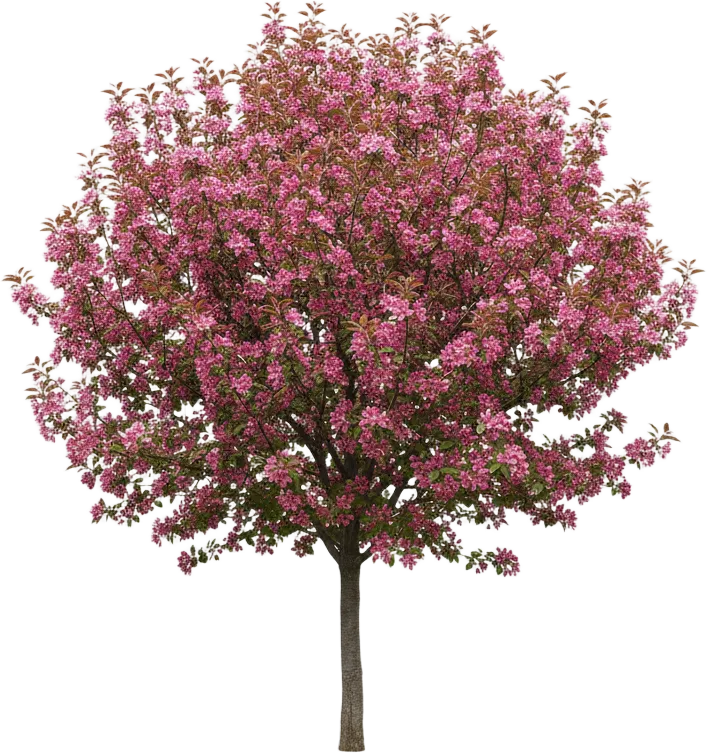
Small flowering trees grown for a cloud of spring blossom, here deep pink-red and lightly fragrant, then small purplish-red fruit that birds eat into winter. Choose a disease-resistant variety, since fire blight, apple scab, rust and mildew are the common troubles, worst in humid summers. Give it full sun.
- Mature size
- 17 × 17 ft
- 5.5 × 5.5 m, tall × wide
- Hardiness
- Zones 4a–8b
- USDA
- Sun
- Full sun
- Water
- Medium to moist
- Blooms
- Apr–May
Crabapple at its mature size
A mature Crabapple grows 15 to 20 feet tall and just as wide, taller than most people.
Drawn to scale beside a 5 ft 9 in person. With VeraScape, you see it at this size in your own yard.
Typical mature size, unpruned. Sources: Missouri Botanical Garden.
Through the year
What Crabapple looks like month by month in a typical zone 6–7 garden.
Dormant · Dec–Mar
Bare branches with some shriveled dark red fruit.
In flower · Apr
Crown covered in dark pinkish-red flowers among new reddish-purple leaves.
In leaf · May–Sep
Dark green leaves with a maroon-purple tint.
Fall · Oct–Nov
Leaves dull yellow-orange with a slight bronze cast, not dead brown; many small glossy dark red crabapples.
Growing Crabapple
- Grows well in
- The Northeast, the Midwest, the Plains and Mountain West, and the Pacific Northwest.
- Good for
- Small space and specimen
- Leaves
- Drops its leaves in winter
Spacing
VeraScape spaces plants so their grown canopies just touch. For Crabapple, that’s about 17 ft apart, center to center.
Place a row in your own yard and VeraScape spaces them at their mature width, so you can see whether they’ll crowd the walk.
See Crabapple in your yard before you dig
Visualize it at its true size, alongside the rest of your design.